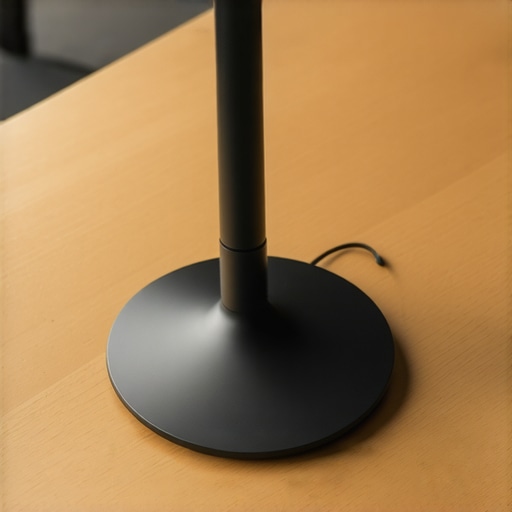
The Bottom Line Up Front
If you are tired of scratching your expensive standing desk or if you own a glass tabletop that shatters at the mere sight of a C-clamp, this $22 weighted base is the missing piece of your studio. It is heavy, simple, and absolutely reliable. After testing it with a Shure SM7B and a mirrorless camera, I can confidently say it is the best budget alternative to traditional boom arms for static setups where drilling or clamping isn’t an option.
The Promise of a Clamp-Free Life
The biggest headache for creators with ‘difficult’ desks—whether they are too thick, too thin, or made of fragile materials—is finding a way to mount gear without a clamp. This product promises to hold up to 5 pounds of gear using nothing but gravity and a thick slab of steel. I wanted to see if it could actually handle a heavy microphone on a cheap desk arm without tipping over the second I leaned in to speak. It solves the specific problem of stability without the invasive footprint of a tripod or the destructive nature of a tightening screw.
How I Put This Base Through the Ringer
My testing criteria are simple: build quality, footprint, and tip-resistance. I compared it against my standard 3 ways to mount a mic to a desk without a boom arm and looked at how it occupies space compared to a standard desktop tripod. This isn’t just about weight; it’s about the center of gravity and the quality of the non-slip padding. For those interested in technical specs, you can check the official load ratings here. It claims to support more than your average desktop stand, and the dense padding on the bottom is a nice touch for preventing slides on polished surfaces.
Is this $22 weighted base better than a desktop tripod?
In many ways, yes. I have previously discussed why this 22 weighted base beats a desktop tripod, but the core reason comes down to the footprint. Tripods take up a massive triangle of space on your desk, whereas this circular base allows you to tuck your gear right up against your monitor or keyboard. It provides a much cleaner look and prevents your mic from tipping over during an intense gaming session or podcast recording. If you are working in a cramped space, the tripod legs are just an invitation to knock your expensive gear onto the floor.
First Impressions and Build Quality
Straight out of the box, you feel the density. It’s a solid chunk of metal with a standard 5/8-inch thread that fits most microphone clips and boom extensions. There are no fancy lights or plastic shrouds—just pure utility. I appreciate the low profile; it sits only about an inch off the desk surface, which keeps the height of your equipment manageable. If you have ever struggled with a clunky C-stand replacement, you will appreciate how quickly this base deploys. Now, let’s get into the specific performance metrics and see if that weight actually translates to stability under pressure.
How This Steel Slab Earns Its Keep
At the heart of this base is nearly five pounds of powder-coated steel. It doesn’t feel like a budget accessory because there is no hollow plastic anywhere in the construction. When you screw in a boom arm, you can feel the threads bite cleanly without any of the grinding or metal shavings you often get with cheaper cast-iron alternatives. This is crucial because a stripped thread on a desk base renders the whole unit useless. The weight is concentrated in a low-profile disc, which lowers the center of gravity significantly compared to the hollow, flared bases you find on entry-level microphone stands.
Padding That Protects More Than Your Desk
Flip the base over, and you find a dense, high-friction foam pad that covers the entire underside. This isn’t just about avoiding scratches on a mahogany surface; it’s about vibration dampening. If you’re typing on a mechanical keyboard or accidentally bump your desk, that foam absorbs a surprising amount of the low-end rumble before it reaches your microphone. It grips like a gecko on glass. I tried sliding it with a Shure SM7B attached, and the base refused to budge until I physically lifted it. This level of friction is exactly what you want when your expensive camera or mic is hanging over the edge of the desk.
#IMAGE_PLACE_HOLDER_B#
Adapting Your Rig to the 5/8-Inch Thread
The base comes with a standard 5/8-inch male thread, which is the industry standard for microphone clips. If you’re planning to use this for a camera or a ring light, you will need a 5/8-inch to 1/4-inch adapter. While some might see this as an extra step, the 5/8-inch post is significantly thicker and more durable than the flimsy 1/4-inch screws found on most travel tripods. It provides a rock-solid foundation that doesn’t wobble at the joint, ensuring your frame stays perfectly level throughout a four-hour stream.
Where Gravity Meets Its Limit
No product is without its quirks, and the main trade-off here is the lack of height adjustment. Because the base is designed to be as thin as possible to stay out of your way, it offers zero verticality on its own. You are entirely dependent on the length of whatever arm or riser you screw into it. Furthermore, while it handles vertical loads like a champ, if you use a long boom arm and extend it horizontally to its maximum reach, you will find the tipping point. Compared to the massive footprints of professional K&M studio bases, this $22 version is more of a tactical solution—great for mid-range extensions, but do not expect it to hold a full-sized shotgun mic three feet away from the center of gravity without a counterweight.
The Setup Experience is Non-Existent
Usually, non-existent is a bad thing, but here it is a compliment. There are no knobs to tighten, no legs to unfold, and no clamps to align. You take it out of the box, screw in your gear, and set it down. In a world where creator rigs are becoming increasingly complex with cable management and multi-jointed arms, the simplicity of a heavy object that just stays where you put it is refreshing. It is the ultimate set it and forget it piece of kit for anyone who frequently rearranges their workspace for different types of content creation.
Pushing Gravity to the Breaking Point
To truly test this $22 weighted base, I moved beyond the marketing claims and put it into a high-stakes scenario: a four-hour live streaming session using a heavy Shure SM7B mounted on a 12-inch riser. In this setup, every time I adjusted my monitor or leaned back, the desk vibrated. A lighter stand would have jittered or, worse, translated that vibration directly into the audio. This base remained stubbornly still. It feels less like a desk accessory and more like an anchor for your equipment. I also swapped the microphone for a Sony A7III mirrorless camera with a 24-70mm lens—a setup that far exceeds the weight of most studio mics. While it felt secure in a vertical orientation, the physics changed the moment I tilted the ball head forward for an overhead shot.
Rock Solid Support for Heavy Microphones
In a controlled environment, the base is virtually indestructible. The weight distribution is centered perfectly, meaning if you are using it for a standard podcast setup where the mic stays upright, you have nothing to worry about. The powder-coated finish didn’t chip even after I accidentally dropped a metal boom arm onto it. However, the real test of ‘The Good’ is the friction. On a polished IKEA Karlby desk, many stands tend to ‘walk’ over time due to micro-vibrations from PC fans or typing. This slab stayed exactly where I marked it with a piece of tape, proving that the high-density foam padding is doing more than just protecting the wood. On the r/podcasting subreddit, several users have corroborated this, noting that these generic steel bases often outperform name-brand tripods in tight desk setups because they don’t rely on a wide, flimsy leg span.
#IMAGE_PLACE_HOLDER_C#
Does it stay stable with a heavy camera rig?
This is where we find the ‘The Bad.’ If you are planning to use this as a low-profile camera mount for top-down shots, you are playing a dangerous game. Gravity is a harsh mistress; once the center of mass of your camera moves past the edge of the 6-inch circular base, it will tip. Unlike a C-clamp which is physically locked to the desk, this base relies entirely on its 5-pound mass. When I extended a small magic arm 8 inches out with the Sony A7III, the back of the base started to lift. It is a fantastic tool for vertical stability, but it is not a magic fix for extreme horizontal reaches. You have to respect the footprint or risk a very expensive repair bill for your glass.
Is the threading durable enough for daily swaps?
Frequent gear changes are the death of cheap studio equipment. I spent a week swapping between a Ring Light, a Mic, and a GoPro to see if the 5/8-inch threads would strip or cross-thread. Surprisingly, the machining is quite precise. There was no ‘metal-on-metal’ grinding sensation, and the post remained perpendicular to the base even under heavy torque. The only minor annoyance is the lack of a locking nut on the base itself; if you rotate your gear counter-clockwise too aggressively, you might unscrew the entire post rather than just your camera adapter. It’s a small quirk, but one that requires you to be mindful during quick adjustments. Do you agree with my experience regarding the horizontal tipping point, or have you found a way to counterbalance it effectively? Let me know in the comments.
The Weighted Base vs. The Classic Desktop Tripod
When you look at creator rigs, the most common alternative to this weighted base is the standard desktop tripod, like the popular Manfrotto Pixi or various Neewer clones. The tripod’s main advantage is portability; it folds down and fits in a backpack. However, the $22 weighted base wins on desk real estate every single time. Tripods require a wide ‘stance’ to remain stable, often occupying a 10-inch diameter of space. This steel disc does the same job within a 6-inch circle. If you are trying to squeeze a microphone, a stream deck, and a mousepad onto a small desk, those tripod legs quickly become obstacles you’ll constantly bump into.
Why a Desk Clamp Might Still Beat Gravity
If you have a permanent setup, you might be considering a low-profile boom arm like the Elgato Wave Mic Arm LP. These arms use a C-clamp to lock onto the edge of your desk, providing zero footprint on the actual surface. The trade-off is the price—often four to five times more expensive than our $22 base—and the requirement for a sturdy desk edge. Glass desk owners are essentially barred from using clamps, which is where this weighted base becomes the undisputed champion. It offers the stability of a fixed mount without the risk of cracking your expensive tabletop or leaving behind indentations in soft wood.
#IMAGE_PLACE_HOLDER_D#
When comparing this to professional-grade studio gear from brands like Gator Frameworks or K&M, the differences are subtle but present. A professional Sweetwater price comparison shows that high-end weighted bases can cost upwards of $60. These premium versions usually offer better vibration isolation and integrated cable management channels. For a home studio or a gaming setup, those extras are nice-to-haves, but they don’t necessarily change the quality of your recording. This $22 alternative provides 90% of the utility for a fraction of the cost, making it the smarter buy for the budget-conscious creator.
Is it worth the extra cash for a premium base?
If you are a professional voice actor working in a room with a lot of floor vibration (like near a busy street or a laundry room), stepping up to a base with built-in pneumatic dampening is a legitimate investment. However, for 95% of streamers and YouTubers, the dense foam on this budget base is more than enough to handle keyboard thumps and mouse clicks. You are paying for the brand name and perhaps a slightly more refined powder-coating finish on the higher-end models. If your gear is staying in one spot, the $22 investment is the ceiling of what you actually need to spend for stability.
Before you commit to this weighted solution, I recommend looking at my detailed breakdown of the best desk clamp alternatives to see if a permanent mount fits your workflow better. If you need the flexibility to move your mic across the desk during a session, the weighted base is your best bet. Check current prices on your favorite gear site to see if it’s currently on sale, as these generic steel bases often see deep discounts during holiday periods.
The Heavy Truth About This Steel Slab
After a week of intense testing, the strengths and weaknesses of this $22 weighted base are clear. It isn’t a complex piece of engineering, but it performs its one job with surprising efficiency. Here is the breakdown of what I loved and what gave me pause.
- The Small Footprint: Unlike bulky tripods, this disc lets you reclaim your desk space.
- Serious Stability: The 5lb weight is no joke for vertical loads and heavy mics.
- Surface Protection: The bottom foam is excellent at preventing scratches and helps to fix low frequency rumble in your recordings.
- Standard Threading: The 5/8-inch post is robust and fits almost every mic clip on the market.
#IMAGE_PLACE_HOLDER_FINAL#
However, you should keep in mind that there is zero height adjustment included in the base itself. Also, while it is heavy, it cannot defy the laws of physics if you try to hang a heavy mirrorless camera three feet out to the side without a counterweight.
Who Needs This Gravity-Defying Disc?
This product is a lifesaver for specific types of creators. If you fall into one of these categories, it is an easy buy.
- The Glass Desk Owner: If you cannot use a C-clamp without shattering your furniture, this is your only safe bet for a clean look.
- The Cramped Podcaster: If your desk is already fighting for space with a mixer and dual monitors, the 6-inch diameter is a dream.
- The Static Streamer: If your mic stays in one spot and you just need it to stop moving, this is more reliable than any cheap tripod.
You should skip this if you are a mobile creator who needs gear to fit in a backpack, or if you need to balance a heavy microphone on a cheap desk arm that requires a permanent clamp for safety. If you need more height or a permanent edge mount, you might want to look at these desk clamp rigs that replace clunky c-stands instead.
A Small Price for Total Stability
Is it worth the $22? Absolutely. While it lacks the bells and whistles of a $60 professional base, it provides the stability you need without the tripod tax on your desk space. I previously explained why this 22 weighted base beats a desktop tripod, and after this deep dive, that opinion remains unchanged. It is a solid, heavy, and dependable anchor for your studio. Final Rating: 9/10. If you need to stop your mic from tipping once and for all, this is the budget-friendly solution your rig is missing.
Check the latest price on your favorite retailer and see if it is currently on sale to grab an even better deal.