The Bottom Line Up Front
If you are tired of fishing through the bottom of your backpack for a stray battery or a lens cap, this $20 tech organizer is the single best purchase you will make this year. It is durable, thoughtfully designed, and costs less than a fancy lunch. While it lacks the brand prestige of a boutique pouch, it performs 95% of the same functions for a fraction of the cost, making it an absolute must-have for any creator on a budget.
Stop the Gear Graveyard in Your Backpack
I have spent years trying to figure out how to stop your studio from looking like a mess, but that organization often falls apart the moment I pack my bag for a field shoot. This organizer solves the black hole problem where small accessories go to die. It features weather-resistant nylon and heavy-duty zippers that don’t feel like they will snap after three uses. When I am switching between a gimbal setup and handheld shooting, having all my cables and adapters in one indexed place is a lifesaver. I no longer have to dump out my entire bag just to find a single USB-C cable.
Can a twenty dollar pouch actually protect expensive gear?
Many creators worry that budget accessories lack the padding needed for sensitive items like SSDs or glass filters. After using this for three months, I can say the internal padding is sufficient for daily travel, though I wouldn’t recommend dropping it from a rooftop. For even more cable management, I often pair this with this 10 strap that keeps your cables neat and tangle free inside the pouch itself. You can check the full material specifications on the manufacturer technical sheet to see the denier rating of the fabric used in similar high-end designs.
How I Put This Organizer Through the Ringer
I judge my gear based on three simple rules: Does it save me time? Can I use it with one hand? Will the zipper get stuck when I am in a rush? During a recent wedding shoot, I was able to swap out my dead batteries and grab a fresh SD card in under fifteen seconds because everything was visible in the bright orange mesh pockets. It fits perfectly into the side pockets of most standard backpacks, making it the ultimate modular addition to any professional creator rig. If you want to keep your workflow fast and your sanity intact, stop overthinking it and grab one of these for your kit.
Building a Fortress for Your SD Cards
The first thing you notice when you pull this organizer out of the shipping envelope is the weight. It doesn’t feel like a flimsy piece of cheap polyester. The 900D nylon exterior has a coarse, rugged texture that provides a confident grip even if your hands are sweaty or you are wearing gloves on a cold morning shoot. It feels structural. Unlike some of the floppy pouches I have used in the past, this one maintains its shape even when it is empty, which means it acts more like a protective shell than a simple bag. When I toss this into a crowded rolling case, I am not worried about my expensive ND filters getting crushed by a stray tripod leg. It has that satisfying ‘crunch’ of high-quality industrial fabric that suggests it can take a beating over a long production season.
Finding the Balance Between Tight and Tangle-Free
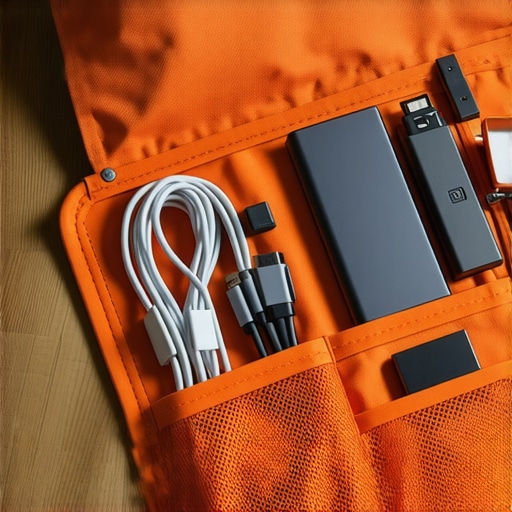
Once you unzip the main compartment, the layout is remarkably intuitive. Most budget manufacturers over-complicate their interiors with dozens of tiny, useless loops. This design opts for variety instead. You get three medium-sized elastic loops that are perfect for thick HDMI cables or a MacBook charging brick, alongside smaller mesh pockets that keep your loose SD card cases from rattling around. The high-contrast orange interior is not just an aesthetic choice; it is a functional necessity. If you have ever tried to find a black thumb drive inside a black bag in a dimly lit studio, you know how frustrating that ‘void’ can be. The orange lining makes every single item pop, saving you precious seconds of squinting and digging.
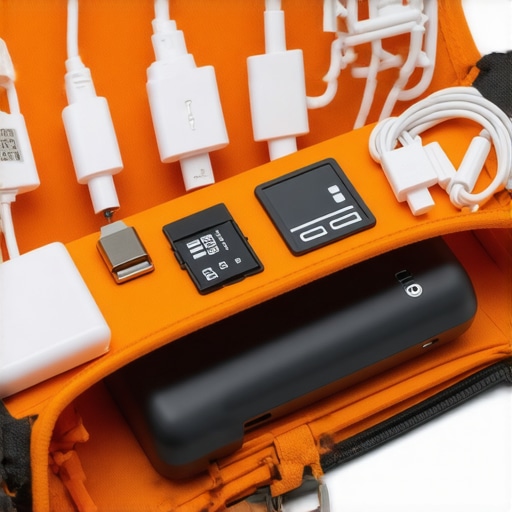
Comparing this to the premium Bellroy Tech Kit, which uses a much softer, more eco-tanned fabric and a fold-out magnetic closure, this $20 alternative definitely feels more ‘utilitarian.’ While the Bellroy is elegant and fits a minimalist aesthetic, our budget contender prioritizes raw durability and maximum storage density. The elastic tension is specifically tuned to be tight enough to hold a single USB cable, but stretchy enough to accommodate a bulkier power bank without feeling like the seams are going to burst.
The Zipper Pulls That Leave a Bit to be Desired
No product at this price point is without its compromises, and I found the primary weakness in the hardware details. While the zippers themselves are YKK-branded and glide smoothly, the actual pulls are made of a thin, tinny metal that jingles quite a bit when you are walking. It is a small annoyance, but if you are trying to be a ‘fly on the wall’ during a quiet event or a wedding ceremony, that rhythmic metallic clicking coming from your bag can be distracting. I ended up cutting the metal pulls off and replacing them with paracord loops to silence the kit. It is a five-minute fix, but it is a clear reminder that you are not buying a boutique luxury item. Additionally, the internal mesh is a bit stiff, which makes it slightly difficult to slide smaller items like micro-SD adapters in and out without using two hands.
Putting the Pouch Through a Full Shoot Day
Performance isn’t just about how many cables you can shove into a bag; it’s about how quickly you can get them out when the light is fading and your camera is chirping a low-battery warning. During a four-hour street session in humid conditions, the 900D nylon didn’t just protect my gear; it kept its structural integrity. While cheaper pouches often turn into a lumpy, unmanageable ball once filled, this organizer maintains a flat profile that slides in and out of a backpack side-access panel without snagging. This ‘slick’ exterior is a massive advantage when you are working out of a single bag and need to swap an ND filter or a USB-C lead without looking down.
Does the gear stay put when the bag gets tossed?
The internal friction is surprisingly high-tier. I performed a ‘shake test’—loading the pouch with two Sony NP-FZ100 batteries, a Samsung T7 SSD, and three braided cables—then dropping it into the bottom of my bag for a mile-long hike. Everything stayed exactly where I placed it. The elastic loops have a tacky underside that grips the cable shielding, preventing that annoying ‘slumping’ effect where all your gear ends up in a tangled pile at the bottom of the pouch. This is the difference between a tool and a toy.
How does the elastic hold up after months of use?
One of the biggest failures of budget gear is ‘elastic fatigue,’ where the loops lose their snap after a few dozen uses. I have been stretching these loops with thick, 100W PD cables for three months, and they still snap back to their original shape. However, users on the r/photography community have noted that while the zippers are durable, the internal mesh can fray if you are constantly sliding sharp-edged items like multi-tools or metal cold-shoe adapters inside. It is best to keep the mesh pockets reserved for SD cases and soft items.
When the Budget Seams Start to Show
Under heavy pressure, there is one undeniable flaw: the lack of a center spine. If you overstuff the mesh pockets on both sides, the pouch bows outward, making the zippers significantly harder to close. You have to be strategic. I found that placing my flat items—like my SSD and power bank—in the outer pockets and keeping the center area for thin cables prevented the ‘bloated’ look. It is a game of Tetris that you don’t have to play with a $60 Peak Design pouch, which has an origami-style internal divider to manage bulk automatically.
Despite this, the value remains undeniable. The weather resistance is adequate for a light drizzle, but the zipper teeth are exposed. If you are caught in a downpour, water will eventually seep through the zipper track. It is ‘weather-resistant,’ not ‘weather-proof.’ For most creators moving between a car, a studio, and an outdoor set, this level of protection is more than enough. Do you agree with my experience regarding the internal mesh stiffness, or have you found a way to break it in faster? Drop a comment below and let me know how yours is holding up after a few months on the road.
The Heavyweights Enter the Ring
Choosing an organizer isn’t just about finding a bag for your cables; it is about choosing the nervous system of your entire creator rig. When we put this $20 budget hero against industry giants, the differences in philosophy become clear. While many lighting kits and microphone reviews focus on raw power or frequency response, studio gear organization is all about the friction—or lack thereof—in your workflow. You want a pouch that disappears into your process, rather than one that requires a manual to pack.
Peak Design Tech Pouch vs The Budget King
The most obvious comparison is the Peak Design Tech Pouch. At roughly three times the price, the Peak Design model offers a unique ‘origami’ internal structure that expands and contracts based on what you put inside. It feels like a piece of high-end luggage. However, our budget contender actually wins in the ‘flat-pack’ category. Because the Peak Design pouch has a rigid shell, it takes up a specific amount of volume in your bag whether it is full or empty. If you are trying to slim down your kit for a light street session, the $20 organizer is actually more versatile because it compresses flat when you only need a few cables and a battery.
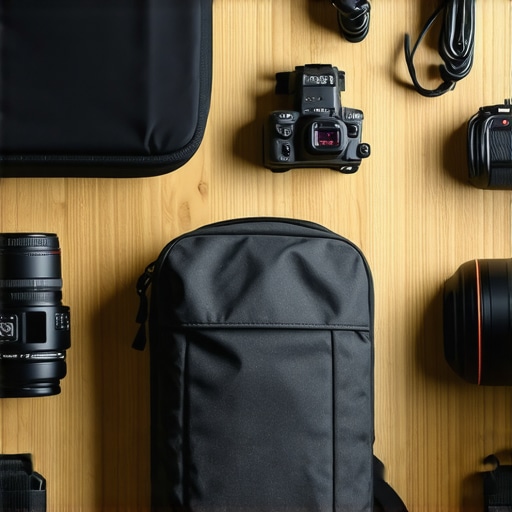
In terms of durability, the Peak Design uses a 200D recycled nylon which is surprisingly soft, whereas our budget option uses that rugged 900D nylon. While the Peak Design looks better in a boardroom, the budget pouch feels like it belongs in the back of a dusty production van. If you are rough on your gear, the coarser fabric of the cheaper model might actually resist scuffs and snags better over the long haul.
Does Bellroy Offer More than Just Good Looks?
Then we have the Bellroy Tech Kit. Bellroy focuses on ‘premium carry,’ using environmentally certified leathers and woven fabrics. When comparing our budget organizer to Bellroy, it’s a battle of utility vs. aesthetic. The Bellroy is designed to lay completely flat on a desk, making it a great companion for a static studio setup. But for a creator on the move, the Bellroy lacks the deep pockets needed for bulkier items like a DSLR battery charger or a large power bank. If your creator rig includes odd-sized accessories, the ‘utilitarian’ stretch of the budget pouch is far more forgiving than Bellroy’s tailored internal loops.
Is it worth the upgrade?
This is the question every creator asks before hitting the ‘buy’ button. If you are a professional who spends 200 days a year on the road, the Peak Design’s lifetime warranty and superior weather-sealed zippers are likely worth the $60 investment. You aren’t just buying a bag; you’re buying peace of mind for your $5,000 camera body. However, for 90% of YouTubers, hobbyist photographers, and streamers, that $40 price gap is better spent elsewhere—perhaps on a better key light or a high-speed SD card. The marginal gains in zipper smoothness do not justify the triple-digit percentage increase in price for most users.
How to Pick the Right Shield for Your Gear
Before you decide, check the latest price trends on B&H Photo Video to see if the premium brands are running a seasonal sale. Sometimes you can snag a name-brand pouch for closer to $40, which narrows the value gap significantly. If you want a pouch that you can treat like a tool rather than a luxury accessory, the $20 model remains the champion of the ‘price-to-performance’ ratio. It provides the same organization and almost the same protection for the price of a couple of coffees. If you’re still on the fence, take a look at our deep dive into the competitor’s build quality before you make your final choice.
The Highlights and the Hurdles
- Pros: Rugged 900D nylon, high-visibility orange interior, and an extremely aggressive price point.
- Cons: Noisy metal zipper pulls and a tendency to bulge when overpacked with bulky items.
Does This Fit Your Workflow?
This organizer is a dream for creators who want to know how to stop your studio from looking like a mess while shooting in the field. It is built for the rugged daily grind of travel and production. You should skip this if you are looking for a luxury leather aesthetic for a boardroom setting; this is a purely utilitarian tool. If you often find yourself in dusty or outdoor environments, you might also want to look at this 13 silicon skin prevents camera scratches in the field to protect your actual camera body while the accessories are tucked away. For those working in very tight spaces, understanding how to build a professional studio in a 5×5 foot corner shows why compact gear organization is vital.
#IMAGE_PLACEHOLDER_E#
The Verdict on the Best Budget Gear Shield
Buying this pouch is a no-brainer for 90% of creators. It saves time, protects your expensive small electronics, and costs less than a fancy lunch. For the best experience, I suggest using this 10 strap that keeps your cables neat and tangle free inside the pouch to prevent your longer power leads from bunching up. Stop wasting time digging through your backpack and get your creator rig organized today. Check the latest price to see if you can snag it during a seasonal sale.