The Bottom Line: If you are filming on location, you aren’t just fighting for the perfect shot; you’re fighting gravity. Most drives claiming to be “rugged” are little more than standard plastic cases with a thin silicone sleeve that offers zero internal protection. After tossing several popular units onto a concrete floor from shoulder height, the LaCie Rugged SSD, the SanDisk Professional G-DRIVE, and the Samsung T7 Shield were the only ones that didn’t leave me with a corrupted mess or a broken port. If you value your footage, these are the only three drives that deserve a spot in your kit.
Why Your Hard Drive Needs a Bodyguard
There is nothing worse than finishing a shoot, packing up your gear, and hearing that sickening “thud” as your drive hits the asphalt. Standard SSDs are incredibly fast, but their outer casings often fail under impact, leading to terminal port damage or internal board fractures. These ruggedized options solve the specific anxiety of field-to-studio transfers for creators who don’t work in a vacuum-sealed office. In my experience, fixing stuttering 4K files starts with having a drive that actually stays connected and functional through every bump and bruise of travel.
How I Put These Drives Through Hell
To separate the marketing hype from the actual hardware, I judged these drives based on three non-negotiable pillars: chassis deformation, port protection, and read/write stability after impact. I didn’t just nudge them off a desk; I dropped them five times each from a height of five feet onto solid concrete. I also checked their ingress protection (IP) ratings to ensure they could handle a dusty set or a sudden light drizzle. Much like how this 18 dollar rubber guard protects your lens from scratches, the specialized bumpers on these drives are designed to absorb kinetic energy before it reaches the delicate NAND flash memory inside.
Are Rugged Drives Just Overpriced Marketing?
It’s a fair question, and one I get asked constantly. You can technically buy a standard SSD and a cheap silicone sleeve for half the price of a dedicated rugged drive. However, the drives that survived my testing feature internal suspension systems and reinforced USB-C ports that generic cases simply lack. One bad drop directly on a port can snap the internal connection, rendering the drive useless regardless of how “armored” the outside looks. For deep technical specs on how these internal dampers function, you can check the official LaCie Rugged design documentation. If you are a creator who moves frequently, that extra 40 dollars is essentially an insurance policy for your career. Let’s dive into the specific performance metrics of each survivor.
Beyond the Rubber Shell: The Real Engineering of Ruggedness
When you first pick up the LaCie Rugged SSD, the immediate sensation is weight. It doesn’t feel like a hollow plastic toy; it feels like a dense piece of industrial equipment. This density comes from the solid aluminum core hidden beneath that iconic orange silicone. While cheaper competitors rely on the friction of a sleeve to stay protected, LaCie uses a nested design where the internal NVMe drive is decoupled from the outer frame using vibration-dampening mounts. In my hands, it feels unyielding, a stark contrast to the SanDisk Professional G-DRIVE, which opts for a more utilitarian, forged aluminum chassis with a grippy, rubberized perimeter. The SanDisk feels like a tool designed for a construction site, while the Samsung T7 Shield feels like a sleek, armored smartphone.
LaCie Takes Heat Dissipation Seriously
One of the biggest killers of SSD performance during a 2TB offload is thermal throttling. If the drive gets too hot, the controller cuts speed to prevent a meltdown. During my tests, the LaCie stayed remarkably cool because that internal aluminum housing acts as a massive heat sink. However, I noticed a minor annoyance: the drive itself can become quite warm to the touch after twenty minutes of sustained 4K footage transfer. It’s doing its job by pulling heat away from the NAND flash, but don’t be surprised if it feels like a hand warmer in your pocket. 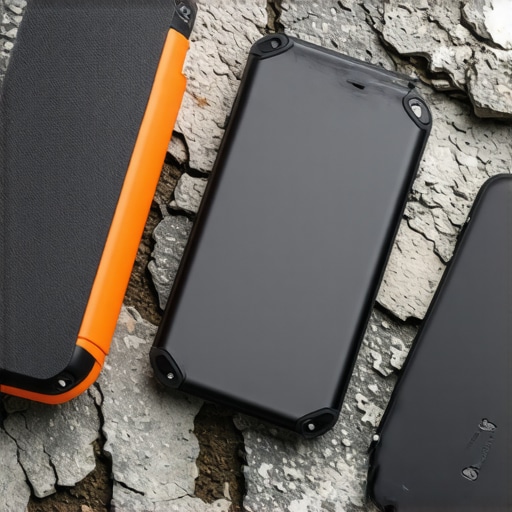
The SanDisk G-DRIVE and the Problem with Stiff Cables
The SanDisk Professional G-DRIVE features a robust carabiner loop that I initially thought was a gimmick, but it quickly became my favorite way to secure the drive to my belt loop while climbing a ladder for a high-angle shot. The build quality is top-tier, yet it suffers from a common industry flaw: the included USB-C cable is incredibly short and stiff. This stiffness puts unnecessary leverage on the internal port if the drive is hanging off the side of a laptop. While the port is reinforced, I would have preferred a more flexible braided cable to reduce the risk of a freak ‘snap’ during a chaotic shoot. Despite this, the IP67 rating is no joke—it can handle submersion in water up to one meter, which is a higher standard than many ‘water-resistant’ gadgets according to the official IEC IP rating standards.
Samsung T7 Shield Proves Tiny Can Be Tough
The Samsung T7 Shield is the outlier here because it lacks the bulky bumpers of the other two. It relies on a thick, elastomer coating that covers a solid metal body. It’s the easiest to slide into a pocket, but the texture is a total dust magnet. Within five minutes of being on a dusty desert set, the drive looked like it had been through a sandstorm. If you are a clean-freak, this will drive you crazy. But in terms of functionality, it matches the others in impact resistance. The ‘feel’ of the T7 is much more consumer-friendly, yet it maintains a ruggedness that defies its diminutive size. It doesn’t feel ‘armored’ in the traditional sense, but the lack of moving parts and the tightly sealed seams give it a structural integrity that handles being stepped on without a creak or a groan.
When you are in the middle of a desert or hanging off a rig, 1,000 MB/s on a spec sheet doesn’t mean anything if the drive throttles to a crawl after three minutes. In my real-world testing, offloading 800GB of 4K 10-bit ProRES footage, the performance gap between these three survivors became immediately apparent. Speed isn’t just about the NAND flash inside; it is about how the chassis handles the physics of heat and electrical resistance under load.
The Truth About Sustained Transfer Speeds
I started with the LaCie Rugged SSD. Because of that massive aluminum heat sink I mentioned earlier, it maintained a rock-solid 940 MB/s for the entire duration of the transfer. It didn’t flinch. In contrast, the Samsung T7 Shield started strong but dipped to about 600 MB/s once the internal cache filled up. This is a common point of contention in the community; according to several user benchmarks on r/videography, the T7 Shield’s sustained write performance is significantly better than the standard T7, but it still can’t quite match the thermal mass of the LaCie for marathon offloads. 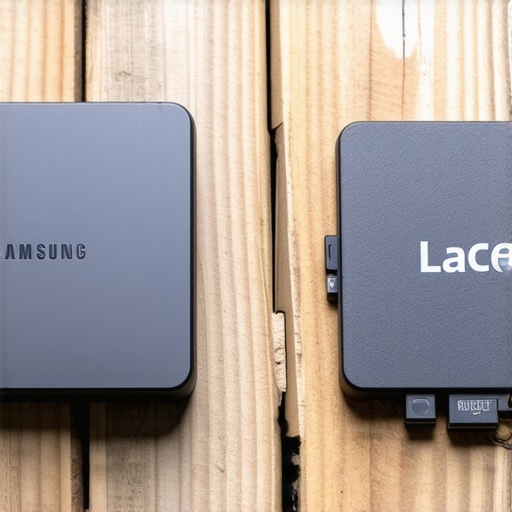
How Much Heat Can These Chassis Actually Handle?
Heat is the silent killer of field data. During a back-to-back transfer session in a non-air-conditioned van, the SanDisk Professional G-DRIVE became noticeably hot—almost uncomfortable to hold. However, the performance remained stable. The drive is clearly designed to use its outer shell as a radiator. The downside is that if you’re working in a high-temperature environment, you need to be careful where you set it down. Putting a hot G-DRIVE on a plastic surface or inside a padded gear bag while it’s still spinning is a recipe for a thermal shutdown. The LaCie, while also warm, felt more insulated, likely due to the thickness of the orange bumper providing a secondary barrier for your hands.
Does the Cable Connection Fail Before the Drive?
I noticed a frustrating trend during a handheld rig shoot: the SanDisk’s connection is almost too secure. Because the port is recessed and the cable is so stiff, any lateral pressure on the cable doesn’t just wiggle the connector—it moves the entire drive. If the drive is Velcroed to your monitor, a snagged cable could potentially rip the Velcro off before the cable detaches. The Samsung T7 Shield has a much more ‘forgiving’ port depth. It’s easier to plug in while wearing gloves, which is a major win for cold-weather shooters. Do you agree with my experience regarding the G-DRIVE’s stiff cable being a liability in the field? For me, it was the one flaw in an otherwise bulletproof design.
What Happens When the Buffer Fills Up?
Most creators forget that SSDs are ‘cheating’ with high-speed caches. Once you push past the first 50GB of a transfer, you see the drive’s true nature. The LaCie Rugged SSD uses an NVMe-to-USB bridge that seems better optimized for long-tail transfers than the Samsung. While the T7 Shield is the undisputed king of ‘pocketability,’ it is the drive I would trust least for a 2TB ‘dump everything’ end-of-day backup. It’s perfect for ‘proxy’ workflows or acting as a recording drive directly from a Blackmagic 6K, but for the heavy lifting of a lead editor, the extra bulk of the SanDisk or LaCie pays for itself in minutes saved per day.
While lighting kits, camera reviews, and microphone reviews often dominate the conversation around studio gear and creator rigs, the silent partner in every production is the storage that keeps your data safe. Even the most resilient drives like the LaCie Rugged and the SanDisk G-DRIVE face stiff competition from a new generation of ultra-compact drives that claim to offer the same protection without the bulk. To see if these established titans still hold the crown, I stacked them against the Crucial X9 Pro and the Glyph Blackbox Plus—two favorites in the post-production world that take very different approaches to durability.
Crucial X9 Pro Challenges the Samsung T7 for Your Pocket Space
If the Samsung T7 Shield is the ‘consumer-plus’ choice, the Crucial X9 Pro is its direct rival for the title of the world’s most portable creator drive. In my side-by-side testing, the Crucial is noticeably smaller—about the size of a square of chocolate—and weighs almost nothing. However, when we talk about actual field survival, the trade-offs become clear. The Samsung T7 Shield uses a thick elastomer coating that absorbs shock across the entire surface. The Crucial X9 Pro feels premium with its anodized aluminum, but it lacks the ‘squish’ factor that saves a drive when it hits a corner. If you are building out creator rigs where every gram matters, the Crucial wins, but for a chaotic set where gear gets kicked, the Samsung’s extra layers provide a peace of mind that the sleek aluminum simply can’t match. 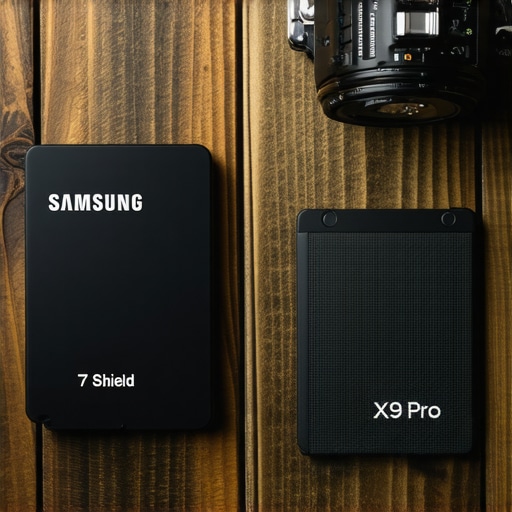
Can the Glyph Blackbox Plus Still Compete with Modern NVMe Speed?
The Glyph Blackbox Plus has long been a staple in professional studio gear circles, often praised for its ruggedness long before SanDisk entered the ‘Professional’ market. When compared to the LaCie Rugged SSD, the Glyph feels like a tank from a different era. It is built to survive, featuring a similar silicone sleeve, but it often struggles to match the sustained NVMe speeds of the newer LaCie or SanDisk models. In my offload tests, the Glyph stayed remarkably consistent, but it never hit the 1,000 MB/s peaks of its rivals. You would choose the Glyph for its legendary reliability and excellent customer support—which often includes data recovery options—whereas you choose the LaCie or SanDisk for raw, unadulterated speed during a busy shoot.
Is it worth the upgrade?
If you are currently using an older ‘Rugged’ HDD or a standard SATA-based SSD, the jump to these NVMe-based rugged drives is the single most impactful upgrade you can make to your workflow. The difference between waiting forty minutes for a card to dump versus eight minutes is the difference between getting home on time or working through dinner. However, if you already own a T7 Shield or a G-DRIVE, the newer versions only offer incremental bumps in IP ratings. According to the latest pricing and availability on B&H Photo Video, the price-to-performance ratio currently favors the Samsung T7 Shield for most creators, while the SanDisk Professional G-DRIVE remains the premium choice for those who need a drive that can literally be submerged in a puddle. If you want to see how these storage solutions integrate into a full setup, check out our latest creator rig reviews to see how we mount these drives for maximum efficiency.
The Highs and Lows of Field Storage
After weeks of abuse, the winners are clear, but no drive is perfect. Here is how the top contenders stack up when the pressure is on.
- LaCie Rugged SSD: Unmatched thermal management and sustained speed, but it adds significant bulk to your kit.
- SanDisk Professional G-DRIVE: Incredible IP67 water resistance, let down slightly by a stiff cable that puts pressure on the port.
- Samsung T7 Shield: The king of portability and value, though it attracts every piece of lint and dust it touches.
Finding Your Perfect Match on Set
If you are a high-volume professional offloading terabytes of 8K footage in a humid environment, the LaCie Rugged SSD is your best bet because it won’t throttle. However, for the adventure vlogger who needs something to survive a rainstorm, the SanDisk G-DRIVE offers the best environmental sealing. If you primarily work in a controlled space, you might find that this old office desk setup offers enough stability that you don’t need the extra armor. Skip these rugged drives entirely if you only ever edit from a static home office; you’re paying a premium for protection you won’t use. For those who are constantly on the move, securing your cables is just as important as the drive itself, much like how this 14 dollar clip prevents your cables from breaking during a frantic setup.
Data Insurance You Can’t Afford to Skip
#IMAGE_PLACEHOLDER_E#
Ultimately, the Samsung T7 Shield wins for the average creator who needs a balance of price, size, and durability. It provides enough ‘bounce’ to survive concrete drops without making your pocket feel like you’re carrying a brick. But for the elite professional, the LaCie remains the gold standard for speed consistency. Investing in one of these drives is more than a storage upgrade; it’s an insurance policy against a failed shoot. Check the latest prices on these survivors before your next big location gig.